The 25-Minute Myth: How Long Should a Focus Block Really Be?
Almost everyone who has tried to focus better has met the 25-minute rule. It works for many people. It also quietly fails for others, and they conclude the problem is them.
Where 25 minutes came from
The technique is called Pomodoro, after the tomato-shaped kitchen timer a university student, Francesco Cirillo, used in the late 1980s to push himself through his studies. He set it for 25 minutes, worked until it rang, then took a short break. The number was a practical choice that happened to work for him, not the result of a laboratory finding.
That matters, because it means 25 is a starting point. If it feels too short or too long for your work, nothing is broken.
Why timed blocks help at all
The trick of a timer is rarely the clock itself. It is what the clock does to your head:
- It makes starting small. “Work on the report” is a big, vague thing to begin. “Work on the report until the ring runs out” is a promise you can keep.
- It draws a line around the work. For the length of one block you are doing one thing, and everything else can wait until the break.
- It protects the rest. Knowing a break is coming makes it easier to ignore the urge to check a message now.
- It shows progress. A finished block is a visible unit of work, which feels better than a day that merely vanished.
All four work with a 15-minute block, a 50-minute block or a 90-minute block. So the question becomes: how long should yours be?
Three rhythms and when each fits
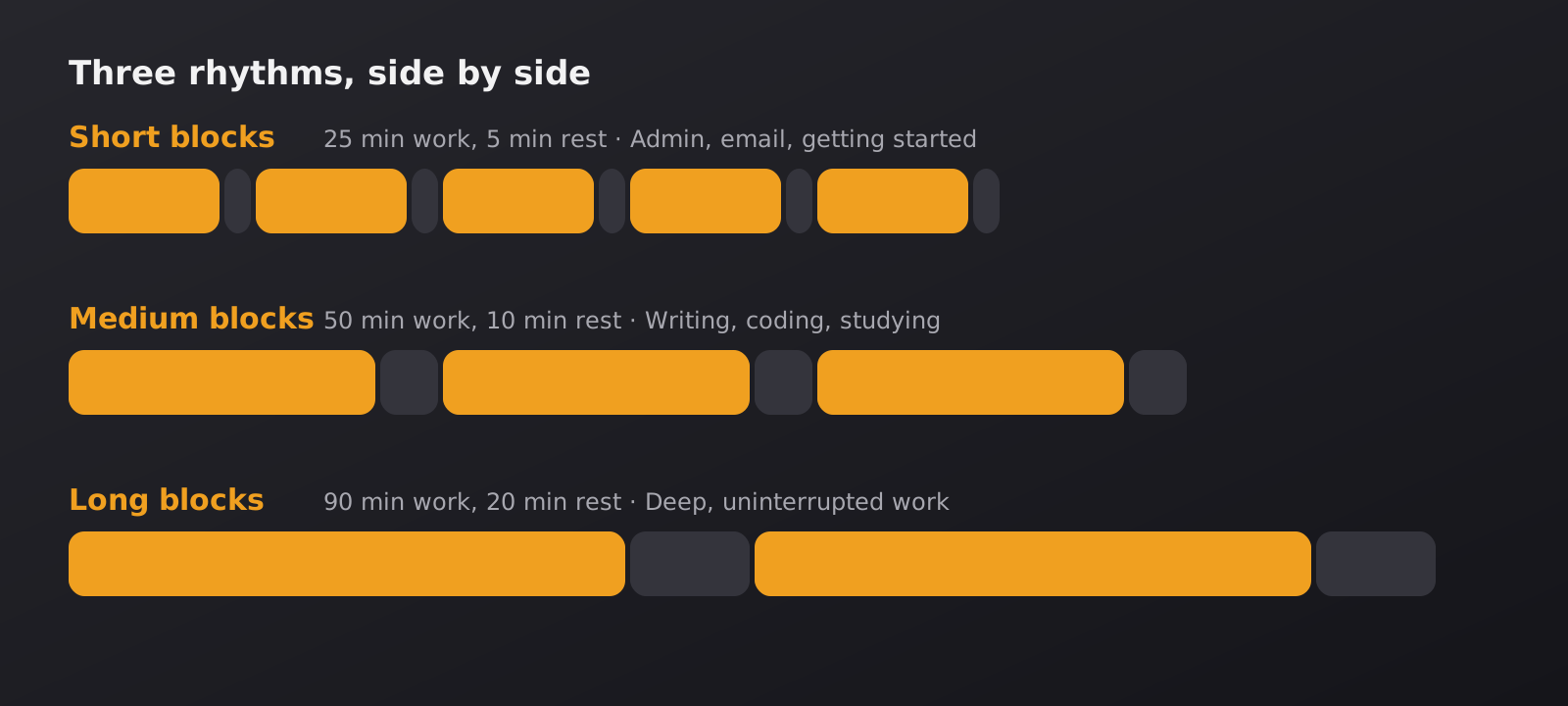
25 / 5: short blocks. Best for tasks you are avoiding, for email and admin, and for days when your attention is scattered. The block is small enough that starting it costs almost nothing.
50 / 10: medium blocks. A good fit for writing, programming, studying and reading a dense document. Twenty-five minutes is often just the moment you finally settle in; fifty gives you time to use it.
90 / 20: long blocks. Some people like ninety minutes for deep, uninterrupted work. The idea draws on research into rest-activity cycles during sleep, and how neatly that carries over to daytime attention is debated, so treat it as an experiment rather than a rule. It only works if you can really protect the time.
How to find your own length
Run a short experiment instead of guessing. It takes about a week:
- Days 1 and 2: work in 25-minute blocks. Note when you drift. Do you feel restless by minute 15, or are you just getting going at minute 25?
- Days 3 and 4: try 40 or 45 minutes. Note whether the extra time feels productive or merely long.
- Day 5: try your most promising length on your hardest task.
- Choose the length where you can usually finish a block without checking something else. Your best number is the longest one you complete reliably.
The break is half of the technique
Many people treat breaks as wasted time and then wonder why they are exhausted by 3 p.m. A good break is part of the work. What to do in it:
- Look away from the screen. Focus on something far away for twenty seconds or more. It rests the muscles that hold your eyes on near objects.
- Stand up and move. A short walk, a stretch or a glass of water.
- Avoid feeds and inboxes. They feel like rest but ask your brain to make decisions all over again.
- Take a longer rest after a few blocks. After four short blocks, 15 to 30 minutes is a typical choice.
Dealing with interruptions
You will be interrupted, by other people and by your own mind. Two small habits help:
- Park the thought. When something pops into your head, write it on a note beside you and return to the block. You are not forgetting it, just postponing it.
- Name the task. Writing down what you are working on before you press start makes it much easier to come back after a break or a distraction.
Setting this up in the Focus Timer
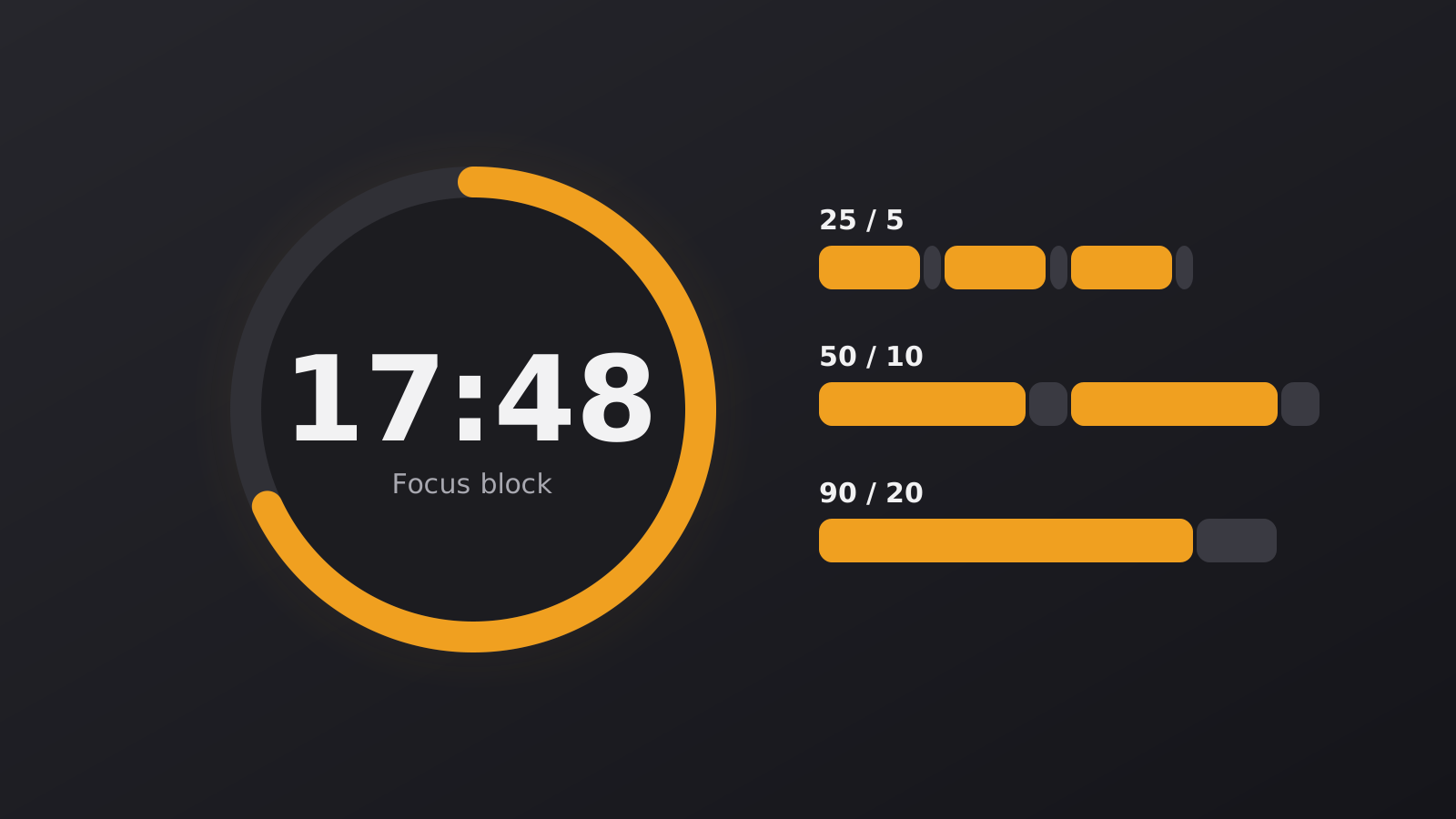
Our free Focus Timer was built around exactly these ideas. You can set the block length anywhere from 1 to 180 minutes, choose the short and long break, decide how many blocks come before the long break and write the task you are on above the clock. A ring shows how much of the block is left, a soft two-note chime marks the end, and a small counter keeps track of the blocks you finished today. It also comes in Classic, Warm, Blue and OLED black tones, so the timer sits quietly beside a dark page. If you read late, our article on dark and light mode explains how to pick the right one.
One more rule: make it easy to win
The best focus block is not the most impressive one. It is the one you actually finish, day after day. Start with a length that feels slightly too easy, protect it, then lengthen it when you feel ready. A small streak of finished blocks does more for your work than one heroic afternoon.
Make your screens a little calmer
Darken websites with the free extension, or open a document in a dark reader that keeps your file on your device.